Watermakers have become essential equipment for comfort and self-sufficiency while cruising, especially on modern catamarans.
These devices, once reserved for large boats equipped with generators due to their high power consumption, have become significantly more energy-efficient for some, operating on 12, 24, or 48 VDC.
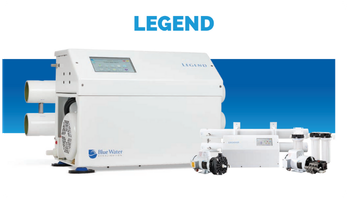
A watermaker turns seawater into fresh, drinkable water using membranes and high pressure through the principle of reverse osmosis.
On a cruising sailboat, it means you no longer have to rely on shore-based water sources and can enjoy almost as much water as you do at home!

In practice, a crew's daily consumption can be quite high: on a catamaran where you aren't being "too" careful, it quickly reaches between 60 and 80 liters per person per day, including hydration (after filtration), cooking, showers, dishes, and cleaning.
For 4, 8, or 12 people on board, that comes to between 240 and 960 liters per day, to which you sometimes add a washing machine, dishwasher, or even a charter chef, which can add another 100 to 200 liters.
The core of the technology is reverse osmosis.
Osmosis is a physical phenomenon found at the heart of all living things. Through a membrane, the less concentrated liquid naturally migrates toward the more concentrated one.
Watermakers use reverse osmosis. This mechanism forces the more concentrated liquid through the membrane toward the less concentrated side, which, unlike osmosis, requires an external energy input: mechanical pressure.
In a watermaker, seawater is pressurized to about 50 to 60 bars, which forces the water through the membrane, allowing the water to pass while retaining salts, bacteria, and most pollutants. This recovers about 10% fresh water, with the remaining 90% returning to the sea as highly salty brine.
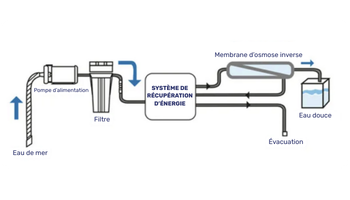
A typical cycle includes: seawater intake, pre-filtration, pressurization, passing through the membrane(s), monitoring the salinity of the produced water, sending it to the tanks if the quality is correct, and automatic membrane rinsing at the end of the cycle.
Recent models automate these steps with remote control panels, sensors, and programmed rinse sequences.
There are two main types of watermakers for recreational boating.
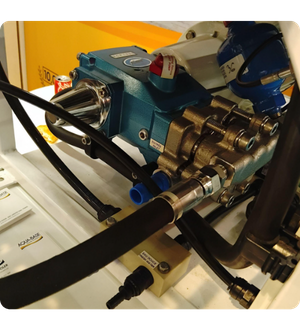
These use a piston pump (often triplex) that directly pressurizes all the seawater before it reaches the membranes.
They are available in 12/24/48 VDC and especially 220/380 VAC versions from manufacturers such as SLCE/Aquabase (Aruba), Dessalator, Rainman, Unitam (Compagnie Hydrotechnique), Aquatec, etc.
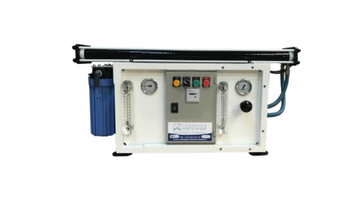
These units are generally paired with generators given their energy consumption per cubic meter of fresh water, which frequently exceeds 12 kWh. Strengths: Mechanical simplicity, few specialized components, and standard parts that are easy to source (pumps, filters, membranes).
Robustness; they tolerate less-than-perfect maintenance and intensive environments (blue-water cruising, chartering, long-distance sailing) better.
Relatively simple maintenance, accessible to a diligent crew.
Weaknesses: High electrical consumption: 8 to 14 kWh per cubic meter of water produced, three to four times more than energy-recovery models.
Higher noise and vibration levels (generated by the high-pressure pump), which require careful installation (silent blocks, flexible mounts, and potentially soundproofing).
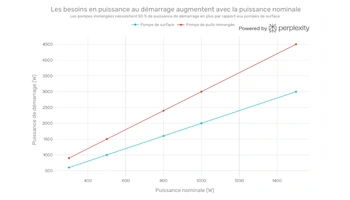
On 220 VAC models, the high inrush current at startup requires properly sizing the generator, inverter, and battery bank, unless soft-start boxes or variable frequency drives are used. The startup spike of an inductive load like a pump can be several times the watermaker's nominal power rating!
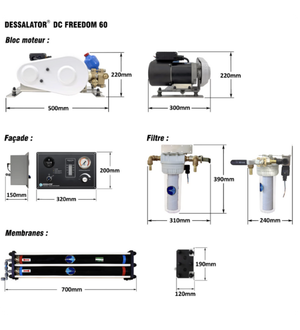
These units recover mechanical energy (from the pressure contained in the rejected brine) to transfer it to the seawater before it passes through the membrane, thereby reducing the required electrical power.
To do this, they use a mechanical device (a piston-driven Clark pump or a rotary exchanger) that transfers pressure from the rejected water to the raw seawater entering the circuit.
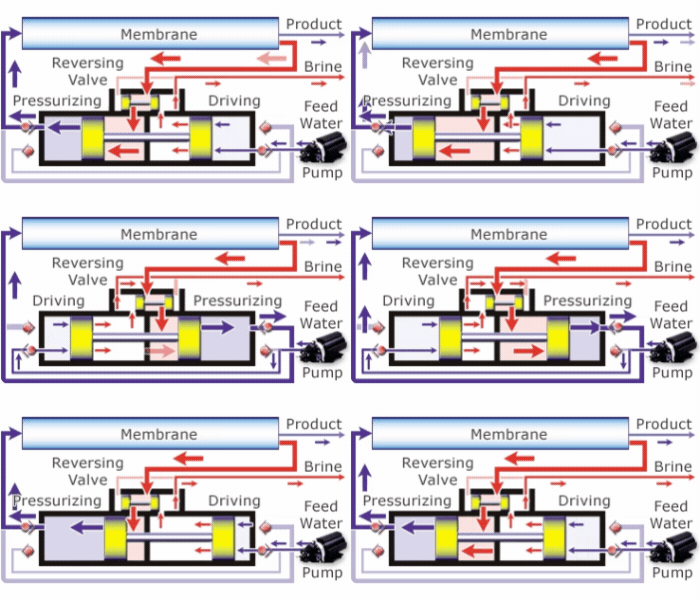
This is a mechanical pump that is not powered by electricity.
Result: consumption drops in practice to 3–4 kWh/m³, which is 25% to 33% of that of a traditional unit.
These are the preferred units for sailboats with limited battery banks or those looking to minimize consumption while at anchor.
Some representative brands: SLCE/Aquabase (Fiji), Schenker, Blue Water, Spectra, Eco-Sistems, and some Osmosea models.
Typical flow rates for 12/24/48 VDC models are around 60 to 100 liters per hour, with "duo" versions that double the output at the cost of increased complexity, as they essentially house two small watermakers mounted in parallel.
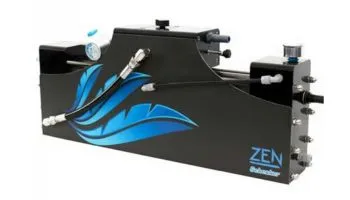
Strengths:
Weaknesses:

The starting point is your daily fresh water requirement, which depends on the number of people, comfort level, and onboard equipment.
A value of 60 to 80 liters per person per day is a realistic baseline, to be adjusted if you have a washing machine, dishwasher, or are using the boat for intensive chartering.
Next comes the question of the strategy for production: running a small unit for a long time or a high-capacity unit for a shorter period.
Producing about 640 liters per day (for 8 people) can be achieved with: a small 50 L/h watermaker running for 13 hours, a 100 L/h unit running for 6.5 hours, or a traditional 200 L/h machine running for about 2.5 hours per day.
In practice, all manufacturers recommend a daily operating range of around 2 to 5 hours.
This leads to a fairly simple logic:
Even though designs vary from one brand to another, the same basic components are always present.
Main elements:
Common sensitive points:
Modern membranes are thin, highly efficient composite structures that require a few precautions during use. They handle pressure well, but are much less tolerant of chlorine, drying out, and long periods of inactivity without flushing.
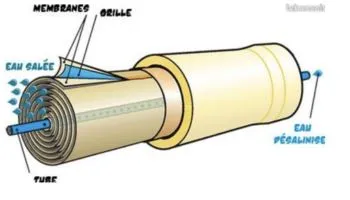
Modern reverse osmosis membranes are Thin Film Composite (TFC) structures, combining several materials to ensure liquid selectivity, mechanical strength, and durability.
A few simple rules for the user:
Where does this chlorine come from? Port water systems are sometimes chlorinated, especially in the tropics. Another source of chlorine contamination is the flushing of new tanks with chlorinated water by manufacturers before shipping. The taste of chlorine indicating the presence of this compound persists on a new boat for two or three full refills of the water tank.
For this reason, some manufacturers include an activated carbon filter in their mandatory configuration.
Finally, it is smart to choose membranes with standard dimensions from recognized manufacturers (Filmtec, Oltremare, Hydranautics, Toray, LG Chem).
If they are standard, the membranes are interchangeable, which simplifies procurement and reduces replacement costs.
Choosing a device suited to your sailing plans, a well-thought-out installation, simple user settings, and minimal but regular maintenance make the difference between a watermaker perceived as fragile and a machine that will accompany the boat through years of happy cruising.
