MPPT (Maximum Power Point Tracking) solar chargers are the most efficient devices for converting light energy collected by your solar panels into electricity stored in your batteries. If you are planning an off-grid solar installation for your boat, understanding how these devices work will help you properly size your system and get the best performance out of it.
An MPPT charger is an intelligent electronic device that continuously adjusts its charging parameters to extract the maximum power from your solar panels. In practice, a solar panel generates voltage and current that vary based on the amount of light, the angle to the sun, and the temperature. The MPPT constantly analyzes these parameters and searches for the "maximum power point," the point where the product of voltage and current produces the highest power (P=UxI).
It tracks the "Maximum Power Point"—hence the acronym MPPT—which is the best balance between voltage and current to obtain the greatest possible amount of energy.
Indeed, a disconnected panel produces high voltage (Voc) but no current, while in a short-circuit (Isc), it produces maximum current but no voltage. The optimal point lies between these two extremes, and this is what the MPPT is constantly seeking.
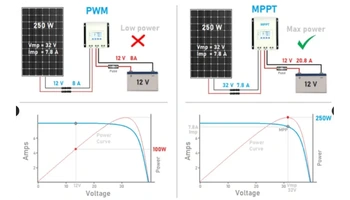
PWM (Pulse Width Modulation) controllers are an older and more basic technology. A PWM simply connects the panel directly to the battery by modulating the current through electrical pulses. Its main limitation is significant: the panel voltage must match the battery voltage, which severely limits possible configurations.
The MPPT, on the other hand, converts energy: it transforms the high voltage of the panels into a voltage suitable for the battery without significant power loss. Comparative tests show that MPPTs can recover up to 30% more energy compared to PWMs, and up to 10% more than less efficient MPPTs. This difference is particularly noticeable in cloudy weather, when sunlight levels are constantly changing.
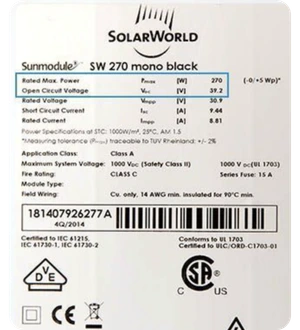
Properly sizing an MPPT is based on three parameters of your solar panels.
The VOC is the open-circuit voltage under STC conditions, i.e., at a temperature of 25°C. This is why you must account for temperature drift in very cold conditions, as the VOC will be higher than the value stated for 25°C.
This is the most important criterion: you must choose an MPPT whose maximum accepted voltage clearly exceeds the total VOC of your panels in series.
For example, if you connect two 22 V VOC panels in series, you get 44 V. This voltage can be used in any 12 V or 24 V system but will be too low for a 48 V system.
To start up, the panel voltage must exceed the voltage the MPPT needs to deliver to the batteries by 5 V; once running, a difference of +1 V is sufficient.
The ISC represents the maximum short-circuit current of the panel. The short-circuit current is used to size protection devices, while the MPPT itself must be sized according to the Impp current.
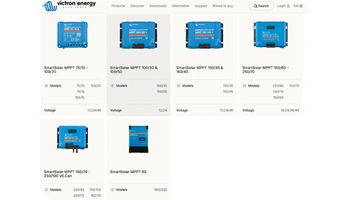
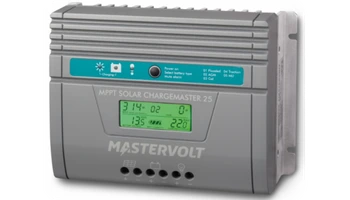
Victron Energy and Mastervolt offer a wide range from 10 A to 100 A of output current.
The nomenclature is clear: a SmartSolar 150/35 accepts a maximum of 150 V at the input and delivers up to 35 A to the battery.
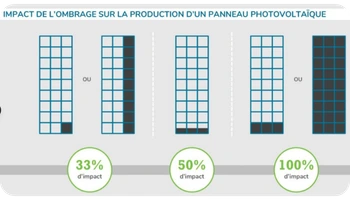
Limit the number of panels per MPPT to reduce the impact of shading
When connecting two panels in series, if one of them becomes completely shaded, it will block the current from the second, even if it is in direct sunlight!
Alternatively, if you connect two PV panels or two strings of panels in parallel and their exposure and shading differ, the MPPT will only be able to calculate an average rather than a true Maximum Power Point, which will lower the overall efficiency.
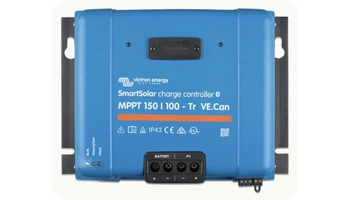
The most modern MPPTs, such as those from Victron Energy, boast exceptional efficiency ratings exceeding 98%. This means that almost all the energy captured by your panels reaches your batteries, with negligible losses. This high efficiency is maintained up to 40°C without a fan, ensuring high power output under standard conditions.
This high efficiency, combined with the affordable price of MPPTs, allows for the use of several low-power MPPTs to avoid the effects described above, rather than using one large unit.
The ultra-fast MPPT algorithm in these modern devices makes a real difference during cloudy periods: it readjusts the maximum power point in a fraction of a second, whereas less capable controllers take several seconds, losing minutes of production every day.
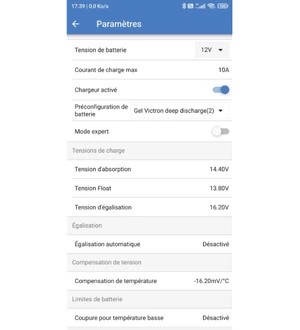
Configuring your MPPT charger must strictly match your battery chemistry. Lithium, AGM, Gel, or flooded lead-acid batteries require different charging profiles with specific absorption, float, and disconnection voltages. Victron Energy SmartSolar MPPTs offer eight pre-programmed, selectable algorithms, or fully customizable programming via the VictronConnect app. This is one of the major advantages of Victron.
This absolutely crucial configuration ensures not only charging performance but, more importantly, the longevity of your batteries by preventing overcharging.
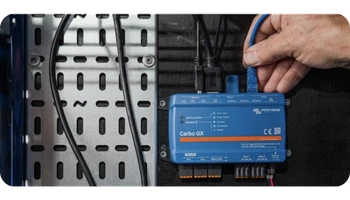
When your installation includes multiple MPPT chargers, a Victron GX device (such as the Cerbo GX) allows you to synchronize them. Thanks to the DVCC (Distributed Voltage and Current Control) function, all MPPTs work together as a single unit. The GX system coordinates the charging voltage required by the battery and ensures charging stops when, for example, a cell in a lithium battery reaches high voltage.
Without a GX system, it is possible to synchronize multiple Victron Energy MPPTs together via the VE.Smart Networking (Bluetooth connection between them), ensuring that the charging stages of each MPPT remain synchronized.
Victron Energy offers a complete range suitable for every project: from the small SmartSolar 75/10 for small campervan setups to the powerful 450/200 for off-grid residential systems. All models include Bluetooth connectivity, allowing you to monitor solar production, battery charge status, and history in real-time via your smartphone.
This modularity allows you to start small and gradually expand your installation by adding additional MPPTs, all orchestrated by a central GX unit.