If there is one useful accessory for a sailor that isn't high-tech, it's the anchor! And yet, there are a good dozen different types, each with its own varied characteristics.
Whether you're into sailing or motorboating, join us as we explore the world of anchors!

Throughout antiquity, the Greeks moored using stones or baskets of pebbles attached to their boats with hemp ropes. The Romans invented the wooden stock anchor.
Improvements in sailing vessels required more efficient equipment, which led to the creation of the metal stock anchor.
The Greeks, skilled navigators of antiquity, used heavy stones and hemp mooring lines to anchor their boats.
Later, the Romans invented the stock anchor carved from wood, an anchor with iron-tipped flukes.
Anchors made entirely of iron appeared at the end of the Roman Empire.
These anchors were hand-forged, which limited their size, and as a result, throughout the Middle Ages, the anchors of large ships were still made of wood and iron.
It wasn't until the 18th century and the progress of industrial metallurgy that we saw the appearance of
large stock anchors made entirely of steel;
In fact, it was advancements in metallurgy that enabled the significant development of sailing navies between the 18th and late 19th centuries. These navies all used stock anchors.
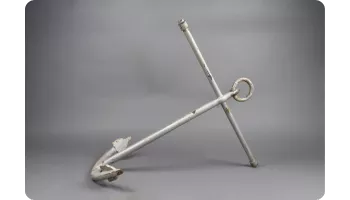
When recreational boating first began, yachts used small stock anchors. However, these are not very effective unless they are extremely heavy.
In fact, their design relies on them pivoting around their stock (the axis) to encourage one of their flukes to bury itself. What works for a two-ton anchor does not necessarily work for a 15 kg anchor.
This led to the creation of a host of specialized anchors, the first of which came from World War II surplus stocks and were none other than seaplane anchors!

American PBY Catalina seaplanes were 15-ton aircraft at takeoff—a weight quite similar to that of a heavy pleasure craft! These planes had two mooring lines equipped with a special type of anchor: the Danforth!
This anchor, a true classic, was born from the US Navy's need to equip its long-range light seaplane, the Catalina, as well as LCI (Landing Craft Infantry) vessels.

After WWII, with 4,000 of these planes built and 1,500 LCIs, anchor stocks were moved to surplus. It didn't take much more than that to launch the Danforth, with civilian production beginning right after the war.
The Danforth anchor is a flat, galvanized steel anchor that is easy to stow.
It generally only engages on one fluke and breaks out easily.
Its "flat" profile when folded makes it a space-saving secondary anchor that is very useful to have on board.
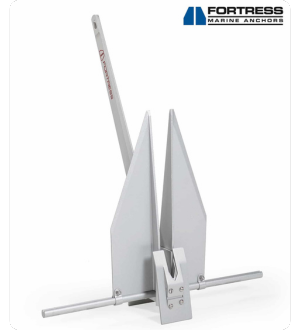
Made of anodized aluminum, this anchor is lighter than the Danforth and has larger flukes. Being lightweight, it makes for a very good secondary anchor.
On Fortress anchors, you can adjust the angle of the flukes relative to the shank depending on whether the seabed is muddy or harder.
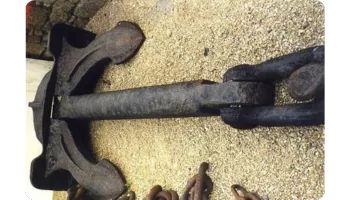
These anchors, inspired by agricultural tools, were born in the United Kingdom during the 1930s. The British archipelago, the home of yachting, already had tens of thousands of small sailing and motor yachts that could not use the large British commercial marine anchors like the Stockless (which still equip most of the world's large ships).
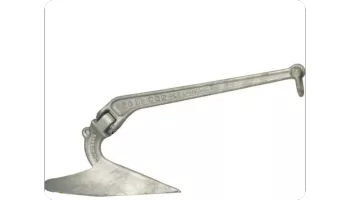
To hold on the muddy seabeds of the British coastline, which are subject to high tidal ranges, anchors that could dig in deeply were required. This is how the plowshare anchor, better known as the CQR, was born. The English pronunciation of CQR—"secure"—speaks volumes about the device's qualities!
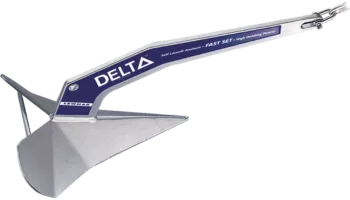
The Lewmar Delta anchor is a CQR without a pivot hinge. It is built as a single piece, which gives it increased robustness. It concentrates its weight at the front, which facilitates digging in and makes it easy to stow. This is what has made it so successful.
The Kobra anchor from Plastimo and the Rock anchor from FOB are also plowshare anchors.

This family of anchors combines the advantages of a concave fluke with a roll-bar system that ensures correct positioning when hitting the seabed.
These anchors feature a plowshare and a roll bar that, theoretically, prevents them from landing upside down.
This is the case for the German Bugel anchor with its nearly flat plowshare.
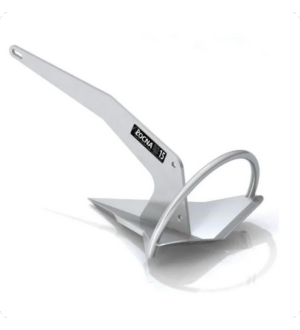
This is also the case for the famous Rocna, which integrates the roll bar of the Bugel with the concave fluke of the Spade, which we will discuss later. Its shank features a very thick tip that gives it exceptional resistance to bending. Its ability to rotate without losing its grip during changes in direction while swinging is its major asset.
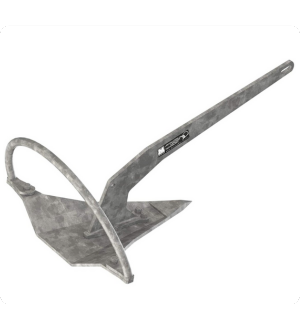
The Mantus anchor can be disassembled for easy storage. It is forged from steel and galvanized.
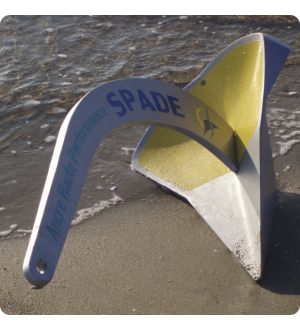
The latest innovation, concave fluke anchors, have a hollow shape that facilitates burial and, much like those with a roll bar, makes it easier for them to position themselves point-down.
The Spade anchor is the best-known of these anchors.
Developed by Alain Poiraud and introduced in 1998, it was an immediate success.
It features a hollow shank that concentrates weight toward the tip to improve holding power. Available in galvanized steel and 316 stainless steel, the hollow shank tube offers several times the resistance to deformation compared to a conventional anchor.
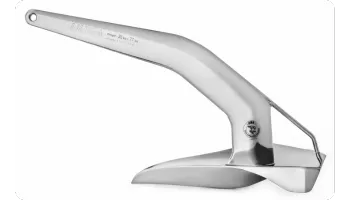
The Ultra-Marine is an advanced version of the Spade anchor. It still features a hollow shank, but also includes a lead weight inside the tip, integrated into its 316L stainless steel construction, to further increase the weight of the point.
On the sides of the fluke, it has two types of stabilizers to ensure consistent penetration. Finally, the shank is equipped with a welded bar that prevents the chain from wrapping around the anchor.
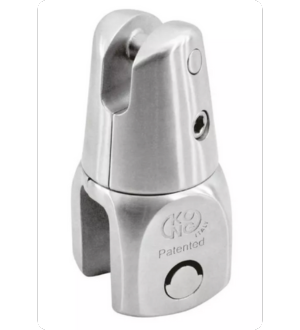
A swivel is an essential component for a proper anchoring setup. It ensures the anchor can rotate freely at the end of the chain.
The swivel must be sized appropriately for the chain and the anchor.
A chain snubber, mooring snubber, or chain hook is essential to relieve the windlass from the strain of the chain. Windlasses are not designed to withstand the forces of a pulling boat!
It is common for these windlasses to be ripped out under load.
Cleats are securely connected to structural reinforcements on the hull, which is why snubbers are almost always intended to be attached to cleats.
Only the bridles on certain catamarans are attached to rings which, like cleats, are securely fixed to structural reinforcements.
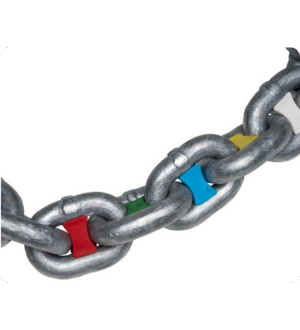
Whether using paint or small plastic markers, marking the chain allows you to know exactly how much chain has been deployed.
They are well worth the time spent or the investment made.
A chain counter is also effective, though more sensitive; if the chain skips a link on the gypsy, it will lose the count!

Whenever you anchor in more than 5 to 6 meters of water on bottoms other than sand, you run the risk of getting your anchor snagged under or in an obstacle.
It’s hard to dive 30 feet without air… To avoid any mishaps, using a trip line is highly recommended.
The Ultra Marine trip line ring is a clever weighted mooring ring that not only adds weight to the front of the anchor but also serves as a support for a trip line… Smart!

The virtual anchor is an innovative concept, reserved for twin-engine boats equipped with a bow thruster or single-engine boats equipped with both bow and stern thrusters.
An electronic computer—usually the joystick controller capable of operating this equipment simultaneously—tracks the GPS position you want to maintain and automatically engages the engines and thruster(s) to hold your position.
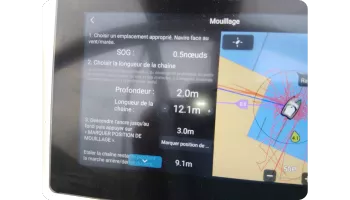
Anchor alarm apps run on phones or tablets. They use the device's GPS to track the boat's location and calculate whether or not it has drifted outside the user-defined swing radius.
On a phone, they only work locally, but if you leave a phone or tablet on board, some of these apps can send an SMS to another device—enough to ruin your dinner, but ensure you find your boat safe and sound.
Some chartplotters, such as the Raymarine Axiom with Lighthouse, offer the same service. An alarm will beep at night if the anchor drags. You can sleep soundly!
