Discover the different types of outboard motors here.
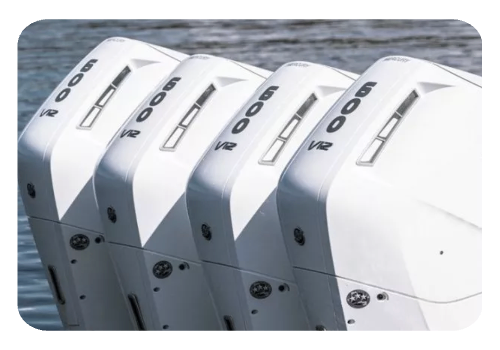

Gasoline-powered outboard motors are the most common. These engines accept standard unleaded (SP98, SP95) as well as blends like E85.
As a reminder, this fuel contains 15% ethanol, a plant-based fuel.
Conversion kits have appeared on the market, but it is important to keep in mind that ethanol promotes water accumulation in tanks and the degradation of fuel lines.
Current gasoline outboards feature powerheads with 2, 3, 4, 6, 8, 10, or 12 cylinders!
All current outboard motors are naturally aspirated (no turbo).
Power is achieved the "old-fashioned" way with fairly large displacements, up to 7 liters for a V12 Verado!
Gasoline outboard motors reach their peak torque at high RPMs, which negatively impacts fuel consumption—on the most powerful models, this can easily exceed 26 gallons (100 liters) per hour!

When fuel consumption becomes a major factor—specifically when navigating more than 300 hours per year—diesel outboard motors take the lead.
While more expensive and complex, they are also more fuel-efficient and require less maintenance.
OXE, a specialist in these products for the professional market, has calculated that at 1,500 hours of annual use, a diesel outboard is half as expensive as a gasoline one, all costs included, even accounting for engine depreciation.
These engines are expensive to purchase but offer better efficiency than gasoline models.

The final category of outboards is electric outboard motors.
These motors have a huge advantage over internal combustion engines: near-instant torque from low RPMs.
In naturally aspirated internal combustion engines, maximum torque is only reached at high RPMs, a range that is rarely used in real-world conditions. For this reason, power comparisons can be based on torque rather than horsepower.
Because of this, electric motors have significantly lower power ratings when their torque values are compared to internal combustion engines operating at mid-range RPMs.
And it is precisely the torque that turns a boat's propeller!
On these charts, you can see on the left that the maximum torque of an electric motor is available right from startup, whereas it is only reached at high RPMs for an internal combustion engine.
To reach this maximum torque, an electric motor requires significantly less RPM and power than an internal combustion engine. For instance, at 1,000 RPM, the electric motor already has 100% of its torque, while the internal combustion engine only has 20%.

Small electric outboard motors have made a meteoric appearance in the dinghy and trolling motor market. Lightweight and high-torque, they are perfect for a dinghy intended for short distances or as a trolling motor for fishing.
Temo, a small electric motor of only 450 W but capable of propelling
an inflatable boat efficiently with the power of a blender!

However, heavier boats have much greater propulsion needs. To power a RIB, a pilothouse boat, or a center console, you need 150, 200, or 300 HP.
This requires a different voltage range.
An ecosystem of manufacturers now offers powerful electric motors.
The best-known is the Norwegian company Evoy, which offers a complete range, including the Storm, a 225 kW (300 HP) motor capable of power peaks of 600 HP (450 kW)!
