What do the specifications of an internal combustion engine actually mean? Where do torque and horsepower come from? How do the propeller and RPM affect engine performance and fuel consumption? Find out with us what happens inside the engine compartment (or an outboard motor).
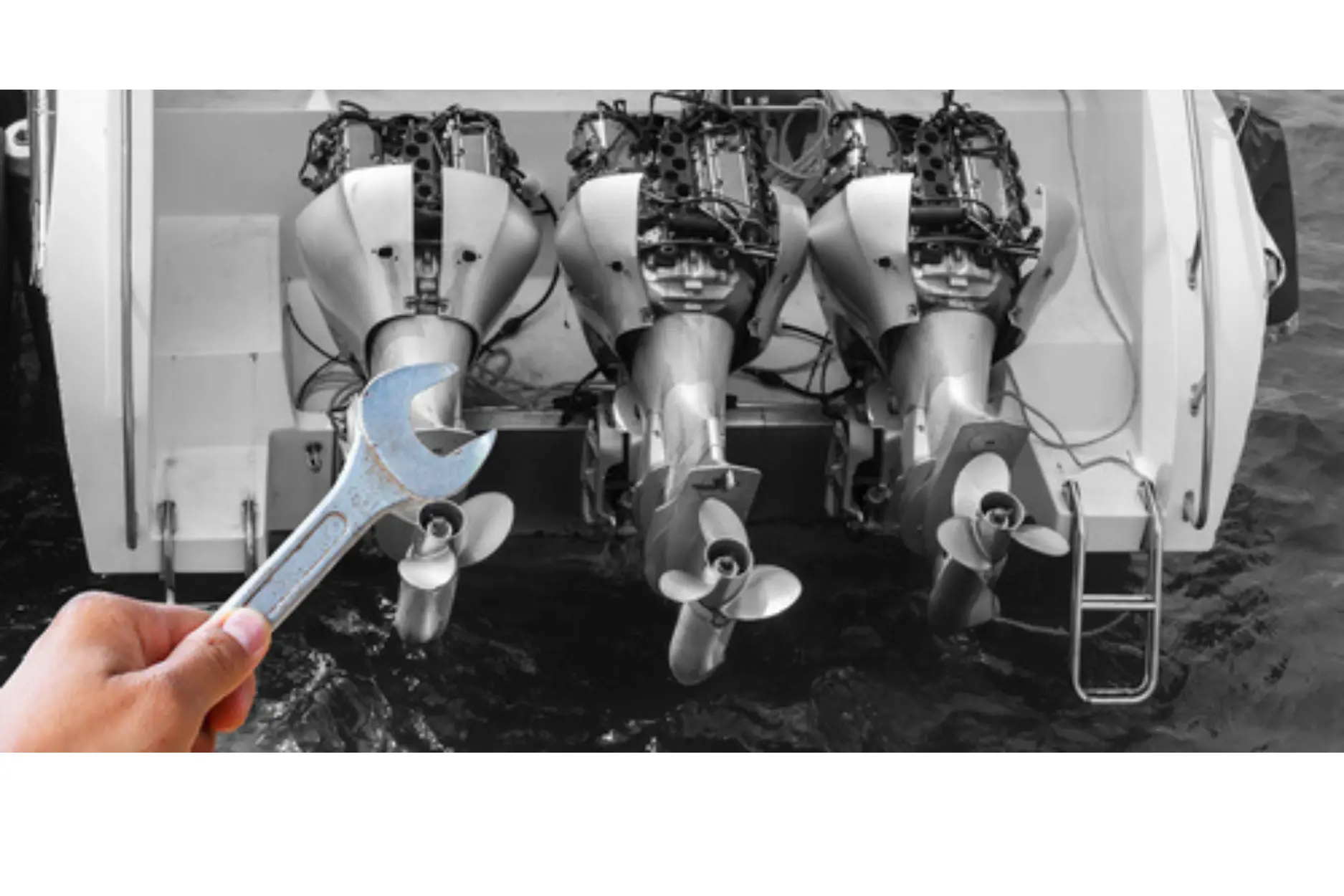
Engine speed is measured in revolutions per minute (RPM) and is shown on the tachometer. It represents the number of rotations of the crankshaft, the component that converts the reciprocating motion of the pistons and connecting rods into rotational motion.
The maximum RPM is the engine speed that its settings should not allow you to exceed.

This value represents the force applied by the piston lever arms to the crankshaft. It is the torque that turns the propeller.
An engine with larger cylinders (higher displacement) holds a greater volume of explosive air-fuel mixture than one with smaller cylinders. The explosion in a large cylinder is more powerful, resulting in greater force—or torque—on the crankshaft. Torque is measured in Newton-meters (Nm).
Power is the product of torque multiplied by engine speed. The faster the engine turns, the higher its power output.
Power represents the work performed by the engine.
It was traditionally expressed in horsepower (HP).
One HP is the power required to lift a 75 kg weight at a speed of 1 meter per second.
One HP is equal to 736 Watts or 0.736 kW. The Watt is the international unit of power. 1,000 Watts make one kilowatt (kW).

For all engines, whether gasoline or diesel, power can be visualized as an upward-sloping, convex curve, where maximum power is reached at high RPM.
This maximum power, achieved at a constant load (the work demanded), is called the engine's rated power.
On the graph representing this curve, engine speed is shown on the x-axis (horizontal) and power on the y-axis (vertical).
Regarding propellers, various factors such as the number, surface area, and shape of the blades influence the energy required to drive them at different rotational speeds. For each propeller, a specific curve can be plotted, showing the power required (on the y-axis) as a function of engine speed (on the x-axis), using the same units as those of the engine power curve. This curve is generally concave in shape.
The unique intersection of the engine power and propeller power requirement curves represents the maximum, or rated, power point, and occurs at the highest RPM of the largest propeller compatible with the engine.
This is the basis upon which propellers are sized in relation to engines.
Regarding fuel consumption, the efficiency of an internal combustion engine varies depending on its RPM and the applied load.

Each RPM corresponds to a specific fuel consumption, which is represented on a separate curve. Fuel consumption fluctuates according to the engine's efficiency at different speeds, with an optimal efficiency range. It is therefore preferable to operate the engine within the most economical consumption ranges, identified as green zones on the specific fuel consumption curve. More precisely, optimal operation occurs between the propeller power curve and the power or torque limit of the specific consumption zone, typically between 1800 and 2500 RPM for a diesel engine and between 2500 and 5500 RPM for a gasoline engine.
Consulting a specific fuel consumption curve helps visualize the effects of over-revving and under-revving. In both situations, consumption increases sharply as soon as you move out of the green or central specific consumption zone. You consume more when under-revving or over-revving.

To reduce energy waste, using a variable-pitch propeller is highly beneficial.
The Overdrive propeller, offered by Gori, is an effective solution. This technology allows you to reach the same speed at a lower engine RPM by increasing the propeller pitch, which increases the load on the engine.
However, this method is primarily suited for favorable weather conditions, as it involves using a propeller with a higher pitch than that normally recommended for the boat's maximum RPM. This approach is based on the principle of converging the engine and propeller power curves at a second optimal point.
It is clear from the previous graph that internal combustion engines are generally inefficient in terms of performance (the ratio of energy consumed to energy produced).
Another strategy to improve the energy efficiency of internal combustion engines is to apply an external load to the engines. The goal is to add a load whose operation costs as little as possible in terms of energy.
On the colored graph above, at a speed of 2000 revolutions per minute (RPM) and a torque of 25 Newton-meters (NM) at the propeller, the engine is in a low-efficiency zone.
By increasing the load to 150 NM while maintaining the same RPM, efficiency improves significantly, more than doubling compared to the 25 NM load. Although fuel consumption increases with the load, the energy produced by the engine is also more than doubled, making this approach advantageous in terms of energy efficiency.

Adding a load to an engine can mean, for example, using it to generate electricity.
This is the principle behind an alternator. Heavy-duty alternators are devices capable of delivering up to 3 kW at peak; they draw their energy from the engine's movement and are set to operate in the low-efficiency RPM ranges.
Using these devices on an internal combustion engine allows for generating a significant amount of electricity without a massive increase in engine consumption. The increase in consumption is masked by the improved overall efficiency. The "wasted" energy is routed to a device that produces electricity.
It’s a virtuous cycle!
