Whether sail or power, monohull or multihull, heavy or light, recreational or professional, almost all vessels are equipped with a propeller. Behind this word lie objects that vary greatly depending on what is required of them. What are the characteristics of propellers?
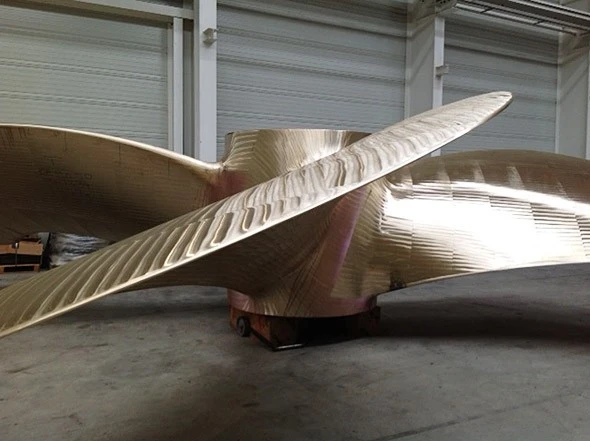
The propeller blades rotate downward, pushing water toward the rear. Water rushes in behind the blades to fill the void created. This generates a pressure difference between the two sides of each blade: positive pressure on the bottom face and negative suction on the top face. The propeller is thus both pushed and pulled through the water.
Propellers generally have two markings (two numbers), for example "13 ¾ x 15". The first number indicates the diameter in inches (1 inch = 2.54 cm) and the second the pitch, also in inches.
Propellers generally have 3 or 4 blades. The more blades there are, the better the efficiency, as the total surface area of the blades increases:
- Two-blade (folding) propellers on sailboats minimize (low) drag while under sail
- 3-blade propellers favor speed
- 4-blade propellers offer more thrust and stability but less speed
Submarines have propellers designed to rotate at low speeds to avoid noisy cavitation, which would make them detectable. They use six- or eight-blade propellers. Some of these are mounted in tunnels to further limit the effects of cavitation, similar to jet propulsion.

The diameter is measured between the tips of the blades. The larger the diameter, the more torque the propeller delivers, but it also places a greater load on the engine. The diameter must therefore be matched to the engine's power. On outboard boats, some manufacturers offer special gearcases with a higher gear ratio to allow for larger diameter propellers.
Harbor tugs or pushers generally use very large diameter propellers, capable of delivering maximum torque when assisting large ships.
The pitch represents the theoretical distance traveled by the propeller in one full revolution, like a screw driving into wood. It is expressed in inches. This is the parameter that most influences the boat's top speed. The pitch must be perfectly matched to the engine for optimal efficiency.
To understand propeller walk, imagine that your boat's propeller is replaced by a wheel. Press this wheel against the ground and observe the scene from the back of the boat looking forward. In reverse, a right-hand pitch propeller will cause the stern of the boat to drift to the left. A left-hand pitch will produce the opposite effect.
Traditionally, a right-hand rotation propeller is used on single-engine boats. On twin-engine boats, a left-hand rotation propeller is mounted on the port engine and a right-hand rotation propeller on the starboard engine. In this case, the two effects partially cancel each other out. Note that a special counter-rotating gearcase must be installed on the engine equipped with the left-hand rotation propeller.

The "cup" is a small lip located on the trailing edge of the propeller blade. It allows the propeller to grip the water better, thereby improving the boat's handling. This lip artificially increases the propeller pitch. This feature is recommended for heavier displacement boats: by adding cup, you gain the advantages of a low pitch (torque, optimized thrust at low RPM) while benefiting from higher speeds at top end.
For pleasure craft and smaller vessels, the cup delays cavitation at low speeds and allows more power to be transmitted at low RPM. The cup is particularly pronounced on certain outboard propellers.

"Skew" refers to the curvature of the propeller blade surface. Simply put, skew is when the blades of a propeller are curved. Skew allows for a significant increase in blade surface area relative to the propeller's diameter. A high-skew propeller produces less noise.
Submarines, which require stealth, use high-skew propellers. They have a very distinctive banana-like shape.

The angle of attack, also known as "rake," is the orientation of the propeller blade relative to the hub. When the rake varies along the blade, it is referred to as pitch distribution. Rake typically varies from 5° to 20° for pleasure craft and up to 30° for racing.
The greater the propeller's rake angle, the more it will lift the bow of the boat and assist in planing.
