The most common propellers in the recreational boating world are fixed, three-blade propellers. They are found on both outboards and inboards. Robust and free of mechanical parts, these propellers are reliable, but they do not come without drawbacks...

Sailboats use their engines sporadically. When sailing, the fixed propeller is dragged through the water, creating significant... drag, which hinders speed.
To combat this, folding or feathering propellers were developed. Under the hydrostatic pressure of the sailboat while underway, they fold to produce only minimal drag. Gori, Flexofold, and Brunton are the main manufacturers of these propellers. These folding propellers are available with two, three, or four blades.

Matching a fixed propeller to an engine is based on a mechanical compromise. The propeller must allow the engine to operate within the RPM range recommended by the manufacturer and must enable the engine to reach its maximum RPM. Since an internal combustion engine's power curve peaks at maximum RPM, this matching requires sizing the propeller for the engine's maximum power and RPM.
Unfortunately, we all know that we don't use engines only at maximum RPM (and fortunately for their longevity!). By doing this, you provide the engine with a propeller suited for high RPMs, a propeller whose characteristics are not suited for other ranges. It is particularly the engine's efficiency, and in other words its fuel consumption, that suffers.

It would be ideal to be able to adapt the propeller's profile to other engine RPM ranges. That is the job of variable-pitch propellers.
On these propellers, the pitch is adjusted by modulating the angle of the blades. On large ships, the pitch is controlled hydraulically from the bridge. A multitude of propeller pitch adjustment possibilities allows them to be adapted to the specific use. Saving 5% in fuel consumption on a large container ship that consumes more than 10 tons of fuel per hour represents... 15 tons of fuel in a single day!
On recreational vessels, the pitch is controlled mechanically based on hydrostatic resistance.
When motoring, springs incorporated into the hub counterbalance the hydrostatic pressure—which varies according to speed—with an appropriate return force, thereby generating an adapted propeller pitch profile.
This subcategory includes two different types of propellers.
Some propellers modify their pitch when in reverse for better efficiency in the harbor; these include MaxProp or Gori propellers, for example.
Others, more advanced, change it based on the boat's speed (and hydrostatic pressure) and the mechanical load applied to the engine.
Autoprop propellers belong to this latter, sophisticated category.

The final category, also designed for sailboats, is the Gori overdrive propeller.
This propeller has the unique feature of offering two forward pitch settings: a "maximum" pitch and an adjustable pitch designed to perfectly match the engine at cruising speed. The maximum pitch is always calculated based on maximum RPM, which is generally rarely used on pleasure craft.

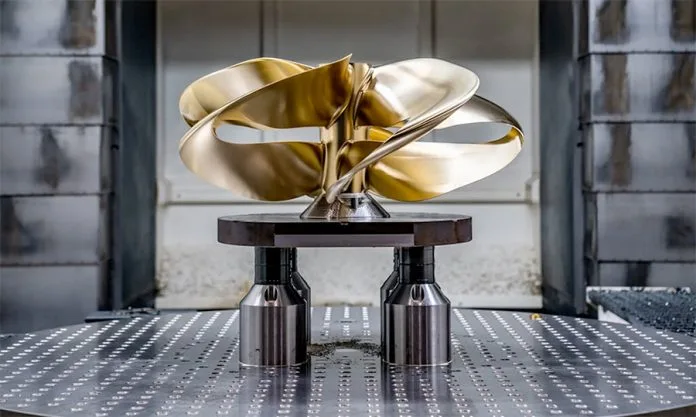
The term "toroidal" literally means "shaped like a closed three-dimensional ring." This is exactly what you see when examining a toroidal propeller, where the blades form loops. This unique geometry provides several major advantages when the propeller is used in water.
In theory, when a propeller rotates in water, it advances a distance equal to its pitch with each rotation. In practice, however, there is slippage, water escapes from the sides, and cavitation and ventilation phenomena occur. The propeller no longer acts on a stable fluid (water) but on an air-water mixture with unpredictable properties, which degrades its efficiency.
Toroidal propellers, such as those developed by Sharrow Marine, significantly improve efficiency by drastically reducing fluid leakage at the sides and strongly limiting cavitation. Their benefits are numerous:
- Significantly higher speeds than those achieved with a standard propeller, especially at low and medium RPM
- A 25% to 30% average reduction in fuel consumption, which increases range by the same amount
- Much better efficiency in reverse and increased "grip" during turns
- Reduced underwater noise
Numerous publicly released tests conducted by Sharrow conclude that there is a significant reduction in fuel consumption, between 20% and 30%. However, you need to do a lot of sailing to recoup their 5,000 Euro retail price.
