Heavy weather and anchoring don't mix! The forecast is in, the gale is confirmed, and things are about to get rough… How can you secure your boat and ride out a gale at anchor?
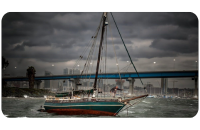

Before preparing to ride out a gale, strong winds, or a depression, if you are on board, you should always ask yourself if you can avoid or flee the storm. Powerboats are poorly suited for this, as it is more of a sailing vessel strategy. A sailboat running before the wind generally takes fewer risks than one at anchor in high winds and the accompanying heavy seas. Of course, you must be able to flee away from the storm's path, away from the coast and out into open water.

If you decide to flee, you must have at least three reefs, or even better, heavy-weather sails—sturdy and small—that allow you to keep sailing while remaining maneuverable in high winds.

Contrary to a common misconception, it is not the anchor that holds the boat at anchor—at least not until the very last resort—but the chain lying on the seabed. The anchor only holds the boat once a significant portion of the chain has been lifted off the bottom.
Letting out more scope is the first thing to do in a gale. But to do that, you need space—lots of space. You need to be able to avoid other boats while swinging and maintain a safety margin. That’s not easy.
Letting out more scope means paying out all your chain—40, 50, or 60 meters, depending on what you have on board—in a depth of water where you will remain safe, even after swinging widely.
Obviously, when letting out a lot of scope and expecting the boat to pull hard, it is essential to rig a chain hook (snubber) to transfer the load from the windlass to the bow cleats. It is wise to double up this snubber. Also, take this opportunity to check that the end of your anchor rode is securely attached to the boat with a line.

The method for deploying a second anchor depends heavily on the situation. If you are on board, you can consider mooring with two anchors (deploying a second anchor and its chain from the bow, each forming a 20 to 25° angle with the boat's centerline relative to the main anchor).
You must be aware of one thing with this method: if the wind shifts, the two anchor lines can become tangled, making it difficult or even impossible to retrieve them using onboard equipment in the middle of a storm.
Deploying a second anchor from the stern with a short scope can help keep the boat in a desired orientation, but here too, if the wind shifts faster than the crew can react, the windage will cause the boat to heel significantly.
Whether you are present (which is highly recommended—you should never leave a sailboat at anchor unattended in a gale) or not, you should, if possible, use tandem anchoring.
Tandem anchoring means deploying two anchors one behind the other, with the second anchor and its chain attached to the end of the main anchor's chain. Tandem anchoring does not significantly change how a boat swings, and there is no risk of tangling—at least not with yourself and your own chain.
In any case, if you have one, prepare a secondary anchor just in case.
If it’s really going to blow, you need to minimize windage as much as possible. Secure the furled mainsail tightly, lower and secure the boom, and remove flexible solar panels from the lifelines. This is also the time to stow the paddleboard.
As for the dinghy, there are two ways to look at it.
Some prefer to keep it tied behind the boat with a long line. We lost one that way; the dinghy's long painter got caught in another sailboat's chain while our boat was swinging, and then it snapped in the gusts. The result: no more dinghy, neither during nor after the gale. It ended up smashed on the rocks, and the motor was stolen. The other solution is to go without a dinghy and store it safely on shore. To each their own. Stowing it on deck is not recommended because if the wind picks up, despite your best efforts to secure it, it will likely end up in the water.
This is also the time to close all hatches, portholes, and companionway doors, and to check that the bilge pump, VHF on channel 16, and engine are all working properly. It’s also a very good idea to take a look at the scuppers to make sure the self-draining cockpits are clear.
Finally, it is imperative that everyone on board puts on a life jacket. It’s also a good idea to eat moderately and stay hydrated.

Once you're in the thick of it, the real test begins when the shrouds start whistling, the chain pulls taut, and the boat heels from the wind shifts and swinging. Everything on the water is in motion, and the sea is full of whitecaps and building.

The question haunting every skipper in the anchorage is the same: is my boat holding? To find out, it’s helpful to keep the chartplotter on with the track visible on the screen. You’ll quickly see if the boat is dragging or not.

A multitude of dedicated apps based on GPS position and the length of chain deployed are available for smartphones.

If the strain is really intense and you feel the anchor is no longer holding the bottom, it’s time to assist your anchor with the boat's engine. The goal is to relieve the tension on the chain by running the engine in slow forward, without overshooting the anchor and risking pulling it out. Ease the tension gently, in forward gear, at very low RPM.
This is an effective method for reducing the load on the anchor rode.
