Outboard motors are much more complex machines than they appear. Renowned for being simple to use and maintain, outboards consist of a powerhead, a midsection, and a lower unit, all in one package.
Whether two-stroke or four-stroke, featuring a powerhead derived from automotive, motorcycle, or purely marine origins, or powered by combustion or electricity, discover the secrets of your favorite engine!

Outboard motors have a history as long as that of inboards.
The idea of mounting an engine independent of the boat significantly simplifies its installation and is nothing new!
The first of these engines, originally two-strokes, dates back to the end of the 19th century. Ole Evinrude, the man who industrialized them starting in 1906, was also the founder of OMC (Outboard Marine Corporation), the largest marine engine company of its time, which reached its peak in the 1960s before disappearing in 2000.

A two-stroke engine is a gasoline engine that completes its operating cycle in two piston strokes. Unlike a four-stroke engine, it does not have valves, but rather ports.
The air-fuel-oil mixture is compressed before entering the cylinder. The oil burns during the cycle, consuming more fuel than a four-stroke.
On the other hand, these engines are significantly lighter than four-strokes. Two-stroke engines are found in small machines like scooters or chainsaws.

Two-stroke engines have seen a slow decline in popularity. This decline is due to two main factors: their noise and their polluting nature.
Evinrude engines were so popular that Disney turned one into a character in The Rescuers: Evinrude, the dragonfly who serves as an outboard motor for Bernard and Bianca.
But the pollution generated by two-strokes proved fatal for them. Two-stroke engines use gasoline mixed with oil at a 4% ratio.
The oil is burned, creating smoke that produces fine particles and pollutants. The era of two-stroke outboards is now over.
This is the advent of four-stroke outboards.
The final blow to two-strokes came in 2004 and 2007 when the EPA (U.S. Environmental Protection Agency) issued regulations to combat marine pollution.
These rules paved the way for four-strokes, which are up to 50% more fuel-efficient, less polluting, and also... significantly more expensive!


The powerhead, or engine block, is the upper part of the outboard. It contains the engine block and its cylinders, pistons, connecting rods, and crankshaft.
The engine block is positioned with the crankshaft axis facing downward, as if you were tilting an inboard engine 90 degrees forward.
Pistons are components that convert the energy from fuel combustion into vertical mechanical energy.
They slide within the cylinders and are sealed by metal rings known as piston rings.

The pistons are connected to the crankshaft by connecting rods.
The crankshaft converts the up-and-down motion of the pistons into the rotational motion required to turn a propeller.
Throwing a rod is never a good thing—whether in life or on your boat—as it means serious damage and engine failure!
The cylinder head seals the top of the cylinders and houses the camshafts and valves.
The powerhead also includes the ignition system—spark plugs and coils—as well as the electric starter, fuel system, and lubrication circuit.

Honda uses its automotive engines for its outboards.
For instance, the 4-cylinder models are based on the Honda K24 VTEC engines from the Honda Accord, while the 6-cylinder models use the J30 or J35 VTEC engines found in the Honda Inspire, Acura, or Accord.

Mercury develops engine blocks specifically for its outboards. Unlike Honda, Mercury supplies engines to the automotive industry, including for the high-performance Corvette ZR1!
Through Mercury Racing, Mercury also offers the SB4, a 7L V8 engine designed for the automotive refit market and intended for pre-1968 hot rod vehicles. 760 HP for classic cars…
On the right, the SB4 in a restomod.
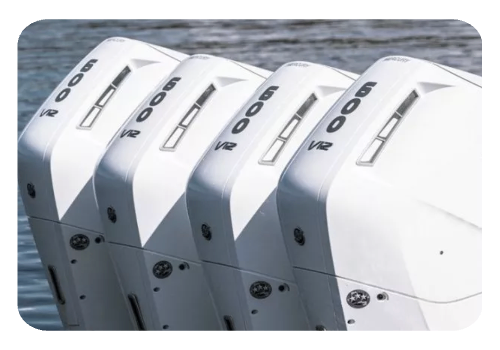
Mercury’s lineup includes the only V12 engine on the market, the Verado V12 with a steerable gearcase (featured in this article's header image), and the company is renowned for the performance of its engines.

Yamaha's four-cylinder engines are historically derived from the brand's motorcycle engines. Yamaha outboards are renowned for their reliability.
The 6- and 8-cylinder models are derived from engines developed for high-performance cars, such as those for Volvo, Ford, or Noble.
Yamaha even supplied a V10 for the Lexus LFA. Will it ever make its way into recreational boating?

This Japanese firm has a completely different history.
Originally specializing in looms, Suzuki shifted its focus after the war toward light mobility and two-stroke transport.
Suzuki's current four-stroke outboard engines are particularly well-regarded for their excellent power-to-weight ratio in the mid-range power segment.

This section connects the engine block to the lower unit.
The midsection contains:
- The mounting bracket for the boat's transom
- The engine tilt mechanism
This electric actuator allows you to adjust the engine's trim while underway, as well as lift the engine out of the water, which is one of the major advantages of an outboard.
- The driveshaft housing and the shaft itself. This is the component that transmits movement from the crankshaft to the gearbox.
- The water pump and cooling system conduits. On an outboard, seawater or freshwater is pumped in and used directly for cooling. This is a primary cooling system, which differs from inboard engines that use a closed-loop primary circuit.

Why flush an outboard?
An outboard cools itself by drawing seawater directly, which its water pump then circulates through the block via tubes.
For this reason, and because this "salty broth" can settle in a hot engine, it is absolutely necessary to flush it with fresh water after every use.
Most recent outboard motors have a nozzle located directly above the lower unit where you can attach a Gardena-style connector hooked up to a garden hose.

On older engines, "earmuffs" are placed over the engine water intakes to supply them with fresh water. The earmuffs are connected to a hose with a fresh water supply.
You can use flush nozzles and earmuffs while at the dock or on dry land.
On dry land, you can also flush your engine by running it in a barrel full of fresh water.

The lower unit is the submerged part of the engine, which includes:
- An angle drive (in the gearbox)
It redirects the vertical rotational movement of the driveshaft and transfers it horizontally to the gearbox and then to the propeller shaft.
- The gearbox
Whether it's a forward-neutral-reverse gear system or a true transmission, most outboards have a gearbox capable of operating in forward, neutral, or reverse. Some of the most modern engines, such as the Mercury Verado 600 V12, also feature two forward gears, making them true transmissions.
- The propeller shaft
- The propeller
- The cooling water intakes
This is the opening through which water is pumped into the engine.
- The flush nozzle
- The skeg
It is a type of heel with a fin that extends below the propeller.
The skeg protects the propeller, aids in stability and steering, and improves the drag of the lower unit.

- The kill switch
A mandatory safety feature that stops the engine if the operator falls overboard.
- Trim tabs: these electric flaps allow you to correct the boat's lateral trim.
- Sacrificial anodes: the outboard motor has an alternator—often underutilized, by the way—that produces current, and stray currents end up in the water. To combat electrolysis and galvanic corrosion of the lower unit or mid-section, which are made of cast aluminum, installing sacrificial anodes is essential.
