One, two, three, four turns of the starter and the diesel won't fire. I have fuel, but the engine won't start. It’s true that it’s freezing cold, but nothing that should stop me from taking my boat out fishing, especially since I’d already drained the freshwater system (see our article).
Another scenario: I start my boat's diesel engine, whether it's summer or winter, and it sputters, won't rev up, and ends up stalling when I press the throttle.
A third scenario: my engine is running normally, but it’s blowing white smoke...
What do these three scenarios have in common? I probably have water in my diesel...
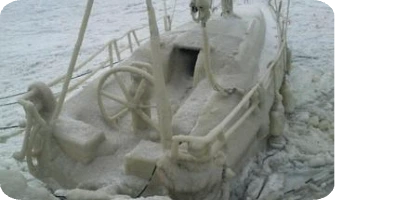
Sea air is loaded with humidity, with levels that can reach 100%. The amount of moisture contained in the air as water vapor varies with temperature. This is Mollier's law.
When the temperature of a solid—in this case, the walls of a tank—drops, some of the water vapor condenses.
What does that have to do with our situation?
Summer or winter, the temperature is constantly changing, and with it, the moisture content of the air. This is a universal and constant phenomenon.
Inside a diesel engine, a second factor comes into play: the fuel return.
Even when a diesel engine is running properly, some of its fuel isn't used by the injectors and returns to the tank; this is the fuel return. As it travels around the block, through the injection pump and the injectors, the fuel heats up before flowing back into the tank. Gradually, the temperature of the diesel rises slightly over the hours the engine is running.
At the end of the day, the outside temperature drops, and with it, the temperature of the air and the inner surface of the tanks. A percentage of the water contained in the air as vapor then condenses on the cold walls of the tanks, and water begins to appear...
The final source of water in the tank is the fill cap and the tube leading to the tank. Water can get in through the cap itself or through a poor seal on its flange...

Even before a breakdown occurs, you can sometimes detect the presence of water in the fuel. This presence is what causes the white color of the exhaust smoke.
When starting up, and while the engine is warming up, it is perfectly normal for the boat to blow white smoke in the winter. Everything is cold, combustion is incomplete, and condensation forms in the exhaust, which is eventually expelled as droplets that give the smoke its color. "Normal" smoke is light and thin.
However, once the engine is warm, thick white smoke indicates the presence of water in the fuel. While condensation and a filter that needs draining are a best-case scenario, the water could also stem from a faulty engine gasket causing coolant to mix with the fuel. This is an abnormal sign that requires investigation.

Engine manufacturers have long since developed ways to avoid these issues. Let’s take a detailed look at how the fuel system of a small diesel engine works.
First, there is the suction strainer, a tube—sometimes equipped with a mesh screen—submerged in the tank. This strainer is located at the very bottom of the tank, an area where sludge caused by diesel contamination tends to accumulate (see our article).
This tube leads to the fuel filter. This component may consist of one or two elements to perform two different functions.
Since the presence and position of these elements can vary, it is helpful to know how to locate them.

Just as an oil filter traps metal particles or large carbon deposits resulting from combustion that have entered the oil through worn seals, the fuel filter traps impurities to protect the injection pump or common rail, and subsequently the injectors.
These components spray fuel at high pressure—between 800 and 1,500 bar—and no solid particles can be allowed to reach them, or they will be severely damaged.
This function can be performed by a cartridge filter dedicated solely to this task, or by a filter combined with a separator.

Since water mixed with diesel is a well-known issue, the separator filter can be a standalone device, or it can be integrated with the solid particle filtration system.
In both cases, the fuel is vaporized within the separator. Being heavier than water, the fuel rises in the filter while the water settles into the bowl.
A drain valve located under the bowl allows the water to be drained.
You must obviously drain this bowl or change the filter to prevent water from accumulating inside. Water buildup can freeze and clog the fuel inlet lines to the filter! This might just be our number one cause of breakdowns.
Draining the fuel filter
To drain the filter, simply take a half-liter container and place it under the filter. Unscrew the bowl valve and let it drain into your container until yellow diesel replaces the flow of clear water. Then, close the valve.
But that’s not all. By opening the fuel filter, you have introduced air into the system, which must be purged to ensure the fuel circuit functions correctly. To do this, use the flexible pump mounted on the supply hose coming from the tank or the manual priming pump mounted on the engine block.
Loosen the bleed bolt on the filter housing. This acts as a high-point air vent.
The priming pump is then used to push the small amount of air that entered the filter out with fuel. When diesel appears at the drain, the air has been purged.

On older diesel vehicles, like my own Defender, we use "radiator muffs," which are covers designed to keep heat in the engine during short trips and also prevent the water content in the separator filter from freezing due to wind chill! During freezing weather, this is perhaps our number one cause of breakdowns!
In "slightly" sub-zero temperatures, you will need to thaw the contents of the bowl or the lower part of the dual-function filter.
A hair dryer works perfectly for this! After about ten minutes, the diesel will start flowing normally again. You will then need to drain the filter, a task that is best performed at the beginning or end of the season.
In very low temperatures, below -4°F (-20°C), the paraffin in diesel—even when additives are included during manufacturing—begins to congeal. It is no longer the water in the separator, but this wax-like substance that solidifies and renders it inoperable. Operating a diesel engine in very cold temperatures requires the use of special additives and, ideally, diesel with a lower paraffin content. To avoid these issues, gas stations offer this type of winter-grade diesel (Type 1) at the pump.

It is reasonable to change the filter cartridge every year, ideally during an oil change or when winterizing the vehicle with a full tank. This prevents condensation by ensuring the tank volume is completely filled with fuel.
Monitoring the separator filter is more nuanced. It depends on your navigation areas and the climate. The more humid the air, the more moisture will be present, leading to more water accumulation in the tank.
A well-placed separator filter is easy to access, and you should check the bowl several times a year.
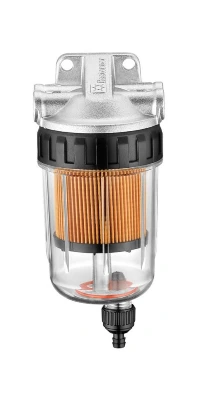
Models with a transparent bowl have an advantage: you can check them at a glance.
Metal models, while still drainable, require a drain/re-priming procedure to check for the presence of water.
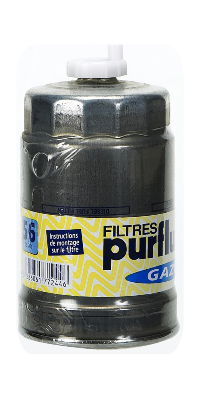
Keeping large volumes of diesel on board while avoiding microbial or water contamination is nearly an impossible mission.
Large yachts, as well as all civil protection vessels or naval ships running on light diesel (the same as our engines), all have an ace up their sleeve: a fuel polishing system.

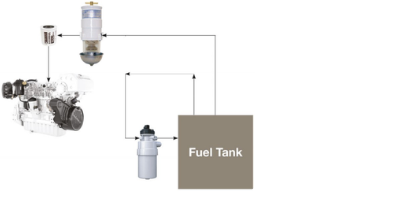
The principle is simple. It involves "polishing"—in the sense of refining or cleaning—a quantity of fuel drawn from the main tank and stored in a second tank, the day tank.
This latter tank is what will be used to supply the boat's engine(s) for a day or a weekend.
It is an independent system equipped with its own circulation pump, and the most advanced versions even feature filter clogging indicators.
Lighter systems designed for smaller yachts do not include a day tank, but their pump works continuously on the diesel in the main tank.
This is the case with the Multipass Fuel Polisher from Racor, one of the specialists in this field.
Diesel engines are robust machines capable of running for over 10,000 hours on a pleasure craft. But this robustness requires both careful maintenance and quality fuel. To ensure that quality, having, understanding, and maintaining a fuel filtration system are great assets.
It is better to understand beforehand and perform preventive maintenance than to discover a separator full of water when the boat has broken down, drifting toward an uninviting, steep coastline!!!
