To properly maintain your diesel engine, you first need to understand it, know what its components do, and be able to locate them. This article is specifically designed to help you learn the anatomy of your diesel engine so you can give it the care it deserves.
A diesel engine consists of a bottom end, a top end, and a certain number of accessories.
Let's take a look at these components!
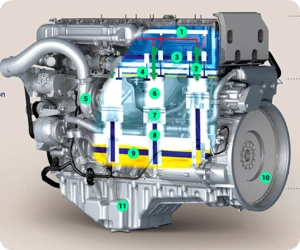
The bottom end first includes the engine block, usually made of cast iron, in which the cylinders are bored.
In the past, cylinders were lined with forged steel sleeves, which allowed for the replacement of liners and pistons through reboring, extending the engine's lifespan.
This is no longer the case today, as recreational diesel engines are equipped with cast iron blocks in which the cylinders are bored directly.

In the bottom end, you will find the pistons and their rings, the connecting rods and their bearings, which transfer the movement of the pistons to the crankshaft, which converts horizontal movement into rotary motion.

Pistons are the moving parts of the engine that convert the chemical energy of combustion into vertical mechanical energy.
They have metal seals that ensure airtightness within the cylinder. These are the piston rings. They are essential for operation under pressure (nearly 30 bars).
The connecting rods link the pistons to the crankshaft, a part that converts the vertical movement of the pistons into the rotary motion needed for propulsion.
It is easy to understand the gravity of "throwing a rod"—an expression that, in everyday life, means losing one's footing, and in mechanical terms, means destroying your engine.
At the bottom, the engine is closed by the oil pan, a sheet-metal, basin-shaped component that collects engine oil by gravity.

The top end first includes the cylinder head, the cast iron part that forms the ceiling of the cylinders. The cylinder head is bolted to the engine block and sealed by the head gasket.

This gasket isolates the combustion chamber from the cooling and lubrication circuits. Its deterioration causes these circuits to leak into the combustion chamber.
The cylinder head houses the valves, the camshaft, the injectors, and the spark plugs.
The camshaft is the moving part that triggers the opening and closing of the intake and exhaust valves.
The cylinder head also includes the intake and exhaust manifolds.
The camshaft is driven by the crankshaft via the timing system. This is usually a timing belt, or more rarely, a chain.
The camshaft rotates at 50% of the crankshaft's speed. It completes one revolution for every two revolutions of the crankshaft. This ratio is essential for the valves to open and close at the right time during the engine cycle.
The valve cover seals the top section.
An internal combustion engine's timing system synchronizes the intake and exhaust of gases within the engine's cylinders.
The timing system specifically drives the camshaft, which controls the valves.
In most cases, the camshaft is mounted above the valves, which is known as an overhead camshaft (OHC) system. This configuration can be single (SOHC) or double (DOHC to improve performance by controlling intake and exhaust valves separately).

The movement of the crankshaft is transmitted to the camshaft by the timing chain or belt. The timing belt is the heart of an internal combustion engine.
It is a toothed belt tensioned between a sprocket mounted on the crankshaft (6) and one or two others mounted on the camshaft(s) (1 and 2).
The belt runs between idler pulleys (3 and 5) and a tensioner pulley (4), which, as the name suggests, adjusts the tension.
A broken timing belt usually results in catastrophic engine failure.
Depending on the manufacturer, it is recommended to replace the timing belt and its pulleys every four to five years or every 800 to 1,000 hours of operation.

Diesel engine lubrication is performed via an oil circuit that is pressurized by the oil pump and sprayed into various parts of the engine.
Internal channels in the block and cylinder head allow the oil to circulate and reach the various high points.
Low points, such as the crankshaft, are lubricated by an oil bath in the oil pan, where the oil returns after each cycle in the lubrication circuit, having passed through the oil filter.
This filter is designed to decontaminate the oil by trapping both metal particles resulting from internal engine wear and pollutants generated by engine combustion.

The oil dipstick is submerged in the bottom of the oil pan.
An oil pump, typically driven directly by the crankshaft or camshaft, pressurizes the lubricant, which is cooled by a heat exchanger connected to the seawater cooling circuit.

The cylinder head cover, or valve cover, is the housing that encloses the space between the cylinder head and the camshaft; it usually features an oil filler port.

In naturally aspirated engines (non-turbocharged), air passes through an air filter before being drawn in by the vacuum created by the piston's downward stroke in the cylinder.

In turbocharged engines, air is compressed by the turbo, which is powered by exhaust gases, as it enters the cylinder.
An intercooler cools the air coming out of the turbo before it enters the engine. Cooled air has a higher density (and therefore contains more oxygen, the oxidizer). The intercooler is also cooled by the boat's seawater circuit.
A turbocharger generally increases fuel consumption but also improves engine efficiency.

The purpose of a diesel engine's fuel system is to spray fuel into the cylinder at high pressure. This generally happens in two stages, starting from the tank.

A feed pump or lift pump draws fuel from the tank and delivers it to the injection pump.
In between, the fuel passes through a fuel filter, which is designed to remove condensation water and prevent sludge from reaching the delicate injectors.
In recreational boating, this feed pump can often be operated manually to prime the diesel circuit after it has been drained.
The injection pump delivers fuel to the injectors at high pressure.

Injectors can be fed directly by a mechanical injection pump; this is the solution found on simpler engines.
In this case, the fuel pressure at the injectors is less than 300 bar (see image on the left).

The common rail system features a high-pressure fuel reservoir (2,000 bar), known as the common rail, where electronically controlled injectors are capable of high individual precision.
Engines with more than 60 horsepower are generally equipped with common rail systems.
Finally, one or more diesel return lines send unused fuel back to the tank from the injection pump. This return flow explains why the temperature of the diesel in the tank rises after hours of operation—a temperature increase that contributes to bacterial growth and the reappearance of sludge in the tanks.
Car engines are cooled by a primary cooling circuit using glycol-water, which is itself tempered by a radiator cooled by air as the vehicle moves.
This is not the case at sea, where diesel engines are cooled by glycol primarily, but things are very different when it comes to the secondary cooling circuit, which uses seawater.

In every way similar to that of land vehicles, the primary circuit consists of a closed loop, drilled into the engine block, through which a mixture of water and glycol circulates.
A circulation pump, driven by the timing belt, ensures the fluid moves.
An expansion tank allows, as its name suggests, for the expansion of the fluid as the temperature rises. It also serves as a fluid level indicator and a filling point.

A mechanical thermostat, placed on the circuit, remains closed as long as the operating temperature is low and opens communication to the secondary seawater circuit when the temperature exceeds 82°C.
To dissipate heat, the primary cooling circuit passes through a chamber filled with seawater—a heat exchanger containing tubes through which seawater circulates; this is the secondary circuit.

This seawater is drawn through a thru-hull fitting; it is essential to know its location, and it must always be open when starting the engine.
If the exhaust does not spit out water as soon as it starts, this is the first point to check.
After the thru-hull fitting and its seacock, the seawater passes through a filter designed to remove debris. It is then drawn in by the seawater pump, which is driven by the accessory belt, and whose impeller should be replaced annually.

Why change it so regularly? Inspecting and replacing it every year prevents debris from the impeller from clogging the pipes, which can drastically reduce the heat exchanger's performance.

Since the consequences of prolonged engine overheating are often very expensive (engine seizure), it is important to keep the secondary cooling circuit in good condition. The condition of the pipes should also be checked every two or three years.
The seawater pump pushes the water toward the heat exchanger. At the heat exchanger outlet, the warmed seawater picks up more heat from the exhaust, where it flows after the exhaust manifold before returning to the sea through the hull exhaust.
This return of seawater is what splashes at the exhaust thru-hull fitting.

To start, preheat, ignite, and sometimes regulate or shut down, a diesel engine requires electrical energy.
An engine electrical circuit is installed, generally separate from the service electrical circuit, also known as the house bank.
The starting electrical circuit consists of an energy reservoir—usually a lead-acid battery—with a high CCA (Cold Cranking Amps) rating, capable of handling the significant voltage drop that occurs when powering a high-draw electrical device like the starter.
A recreational diesel engine starter is a device with nearly 2 kW of power!
The starter battery operates at 12 or 24 V, depending on the setup.
The battery is charged by an electric motor coupled to the combustion engine and driven by the accessory belt.

The accessory belt is driven by the crankshaft, on which a pulley is mounted. Tensioned between rollers, it powers the alternator as well as the boat's seawater pump. The accessory belt generally has a V-shaped profile. It should be tensioned without being overtightened, allowing for less than 1.5 cm of deflection when pressed with a finger.

The alternator is an electric motor that produces current when it is set in motion and its magnetic field is activated.
This happens when the accessory belt drives the alternator and the latter receives excitation current from the battery to activate its magnetic field.
The alternator will feed its current into the engine battery or into a separator/isolator and from there, into the engine battery.
The battery also provides power to the engine, specifically to the starter and the glow plugs when the ignition is on. The positive lead is a red wire, and the starter wire is heavy-gauge to handle the high current it carries. The negative is carried by the engine ground, a metal ground connected to the boat's grounding plate.
The engine electrical circuit is switched on and off by a battery isolator switch to prevent current from leaving the engine battery.
Finally, the engine electrical circuit sometimes controls the fuel shut-off. Diesel engines do not have spark plugs, which, unlike in gasoline engines, would cause the engine to stop if their power supply were cut.

To stop them, you must cut off their fuel supply.
This is done using the fuel shut-off. It is a control that acts on the injection pump and can be mechanical (see image on the right).

or electrical (see image on the left) and take the form of a solenoid valve.
